- Biography
- Books
- Commentary
- Newspapers
- Asian Age
- Bloomberg Quint
- Business Line
- Business Standard
- Dainik Bhaskar (Hindi)
- Divya Gujarati
- Dainik Jagran (Hindi)
- Divya Marathi
- Divya Bhaskar
- Economic Times
- Eenadu (Telugu)
- Financial Times
- Hindustan Times
- livemint
- Lokmat, Marathi
- New York Times
- Prajavani (Kannada)
- Tamil Hindu
- The Hindu
- The Indian EXPRESS
- Times of India
- Tribune
- Wall Street Journal
- Essays
- Interviews
- Magazines
- Essays
- Scroll.in
- Newspapers
- Speaking
- Videos
- Reviews
- Contact
Essays
Union Budget: Investment over consumption in 2022
| February 13, 2022 - 15:25This Budget chooses job creation over freebies and this is a victory
Toolkit for the Indian reformer: The farm laws fiasco offers 7 lessons on how to reform in a democracy
| December 7, 2021 - 15:43 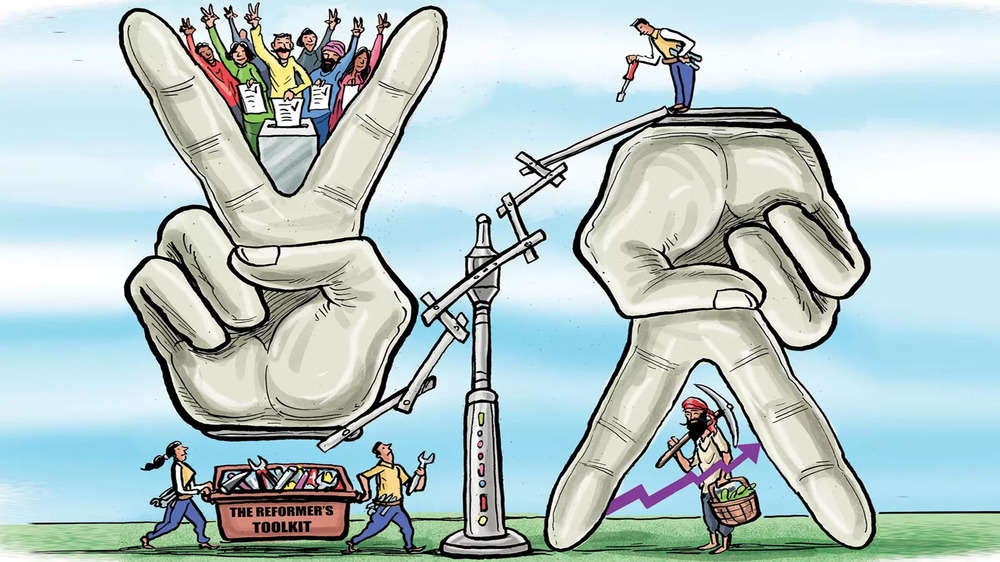
No nation became prosperous without trust between government and business.
| August 30, 2021 - 17:32In the past few weeks, a series of disquieting events have raised the question of trust between government and business. It brought back unhappy memories of the License Raj. Some think that getting government and business to trust each other is hopeless, like getting a pig to sing. ‘It wastes your time and annoys the pig,’ said Mark Twain. Others are wary of crony capitalism, a too cosy relationship between the two. The prosperity of Germany, United States, and Japan has been attributed to high levels of trust between business and the state.
US, India: Stop the uncivil wars: When a nation forgets it’s one people and institutions weaken, we’re at the abyss
| January 12, 2021 - 00:00Indians didn’t know what to think. They woke up last Thursday in disbelief to shocking scenes of President Donald Trump’s supporters overrunning the US Capitol. The deliberate assault on democracy by a sitting president, attempting to overturn a fair election, was an ominous moment in American history.
Don’t kill 2nd green revolution: Rolling back farm reforms would privilege a small but vociferous group over the silent majority
| December 2, 2020 - 00:00The current protests by Punjab’s farmers hold many lessons. One of them is that politics is a short game, a T20 cricket match, while economics is a long term, five-day Test match. Punjab’s farmers are playing the former while the government is playing the latter, which makes it frustrating for the two sides and for spectators in the stands.
Tales Of Trade: How ‘Dharma’ Anchors Business And Markets
| April 6, 2018 - 19:41This is a series based on The Stories of Indian Business Series: 10 Extraordinary Tales of Trade, published by Penguin Random House and edited by Gurcharan Das.
The Dharma of Business: Commercial Law in Medieval India
- By Donald R Davis, Jr.
Dharma, Markets and Indian Capitalism
| January 5, 2014 - 19:42Paper for the Conference on Markets & Morals, New Delhi, 4-5 January 2014
Some nations seem to possess a code word which, like a key, unlocks the secrets of the country. That word is ‘liberty’ in America’s case; égalité, ‘equality’, in the case of France; for India it is ‘dharma’. Some of the best and the worst deeds in these nations can only be understood when seen through the lens of its code word.
Scenes from a Punjabi Childhood
| July 22, 2009 - 00:04(From Remembered Childhood, Edited by Malavika Karlekar & Rudrangshu Mukherjee, Oxford University Press, 2010.)
It was around four 'o clock in the afternoon that my grandfather used to come home from the courts. We would eagerly await his arrival since he always brought home fresh sweets from the Bengali hunchback's shop. As he approached the wooden gate of the house he would clear his throat, and this was a signal of sorts. His daughter- in- law would quickly cover her head; my grandmother would go to the kitchen and put water on for tea; we, his grandchildren, knew that it was the last round of dice in our afternoon game of Pachisi before the scores were tallied. This family routine persisted right through the 1940s.
Foreword to Guy Sorman's book, Year of the Rooster (Full Circle, 2007)
| March 19, 2007 - 12:50After writing a stimulating book on India, Guy Sorman has now written a provocative one on China. China has woken and the world is trembling, but the 'idea of a powerful China submerging the rest of the world is far fetched', says Sormon. Many Western observers, who write on China or India, dwell on imagined countries of the past. Guy Sormon is different. He writes about the ordinary people of today and of 'living' nations and not about mystical fantasies of cultivated Confucian mandarins. The reality that he is sees is disturbing and depressing. The most touching portrait in this book is that of 85 year old Madam Feng Lanrui, who sitting upright in a public cafe, reminds us that 'Democracy is a value common to all civilizations, the undivided legacy of mankind as a whole'. At a time when 'modernism' is not fashionable in the world, it is nice to be reminded about its greatest legacy. Those who confuse modernization and westernization forget that the West too was once pre-modern and pre-democratic.
'Entrepreneurship Entry' in Oxford Companion to the Indian Economy
| March 19, 2007 - 12:46(The Oxford Companion to Economics in India, Edited by Kaushik Basu, Pages 141 - 145, Oxford University Press, New Delhi, 2007)
It is to Joseph Schumpeter, the Austrian economist at Harvard, that we owe our contemporary use of the word “entrepreneur”. Schumpeter took an old word from the economics dictionary and used it to describe what he believed to be the secret of the capitalist system. Capitalism is dynamic and brings growth, he explained, because the entrepreneur introduces technological or organisational innovations, which bring new or cheaper ways of making things. These innovations create a flow of income, which cannot be explained either by labour or capital. The new process enables the innovating capitalist to produce at a lower cost, which raises his profit until other capitalists learn the same trick. Schumpeter's great insight was that this new profit does not come from inherited or God-given advantages but springs from the will and intelligence of the entrepreneur.